
Idaho is rapidly becoming a test bed for how nuclear energy and artificial intelligence can power and accelerate the next generation of computing, with most of the work centered around Idaho National Laboratory (INL) in Idaho Falls.
Setting: Idaho at the crossroads
On the high desert plain of eastern Idaho, an 890‑square‑mile federal site stretches across the sagebrush, roughly 85% the size of Rhode Island. For decades, INL has been known as “the nation’s nuclear laboratory,” where reactors are tested, fuels are developed, and safety standards are pushed forward. Now that same landscape is being reimagined as an AI and nuclear innovation campus, designed to show the world what happens when advanced reactors and advanced computing share the same ground.
The U.S. Department of Energy has formally selected INL as one of just four federal sites that will invite private developers to build AI data centers co‑located with new power generation, including advanced nuclear, geothermal, and thermal storage. For Idaho, that means the line between “energy research lab” and “digital infrastructure hub” is starting to blur.
AI tools for nuclear reactors
Inside INL’s control rooms and computing facilities, researchers are applying AI to almost every stage of the nuclear lifecycle: design, licensing, construction, and operation. They are building AI‑driven engineering workflows that can explore millions of reactor configurations, hunt for safer and more efficient designs, and automatically generate technical documentation that once took human teams years to produce.
A central piece of this effort is the use of “digital twins” of nuclear reactors—virtual models that mirror a physical reactor and stream in near real‑time operational data. INL has already demonstrated this concept on an aging reactor, piping live sensor data into cloud infrastructure and layering multiple machine‑learning models to predict key operating parameters. They are now using cloud AI services from partners like Amazon Web Services to develop a digital twin of a small modular reactor (SMR), the compact, factory‑built reactors many see as the future of nuclear power.
The long‑term vision is that AI will help reactors run more autonomously, continuously optimizing performance, managing complex fuel cycles, and assisting with licensing and regulatory monitoring—without removing human oversight, but radically augmenting it.
Nuclear power built for AI
While INL’s scientists are using AI to improve nuclear, private companies are designing nuclear systems specifically to feed AI’s hunger for electricity and cooling. One of the most striking proposals comes from Deep Atomic, which has pitched “the nation’s first fully integrated nuclear‑powered AI data center campus” at INL.
Deep Atomic’s MK60 is a small modular reactor explicitly engineered around high‑performance computing and AI loads, offering roughly 60 megawatts of electricity, 60 megawatts of integrated cooling capacity, and 200 megawatts of thermal output. The idea is simple but powerful: build a dual‑output reactor that doesn’t just push electrons to servers, but also provides cooling capacity tuned to dense racks of GPUs and specialized AI chips.
Their campus concept starts with grid, geothermal, and solar power to get data center operations running within about 24–36 months, while the MK60 moves through design certification and commissioning. If approved by DOE, this Idaho project is intended to be a national demonstration site—a replicable template for nuclear‑powered AI campuses at federal facilities, national labs, and private operators around the country.
Federal push: Project Genesis and EO directives
Idaho’s nuclear‑AI story is tightly woven into a broader federal strategy, often referred to as the Genesis Mission. This mission, announced via executive order, aims to connect the world’s leading supercomputers, AI systems, and emerging quantum platforms into a single scientific instrument, backed by the largest collection of federal science datasets.
INL is one of the labs helping build this network and the AI tools to use it. The goal is to train large scientific foundation models that can automate research workflows, propose new hypotheses, and accelerate breakthroughs in areas like energy innovation and national security. At the policy level, executive orders have directed DOE to deploy advanced nuclear technologies to support AI infrastructure and to speed up reactor testing and pilot programs, which is partly why about 44,000 acres at INL have been opened for long‑term leases for AI data center and energy projects.
This combination—large‑scale land availability, a legacy of nuclear testing, and national‑level AI priorities—puts Idaho in a unique position to shape how AI infrastructure is physically built and powered.
Partnerships with industry and AI leaders
Beyond Deep Atomic, INL is collaborating with a wide ecosystem of technology and nuclear companies. A strategic partnership with advanced reactor startup Oklo uses INL’s Prometheus AI platform to accelerate reactor and fuel‑system design for Oklo’s concepts, supporting federal missions while reducing design timelines. These AI‑enabled engineering workflows are meant to shorten the distance from concept to operating reactor, something that historically has taken decades.
INL is also working with major cloud and hardware providers. Their collaboration with AWS involves using Amazon’s AI foundation models and computing power to develop tools that could eventually support safer autonomous reactor operation and faster deployment of advanced reactors. A more recent initiative with NVIDIA focuses on cutting nuclear reactor build time in half, using advanced AI modeling and simulation to streamline design, supply chain planning, and construction sequencing for reactors that will feed rising AI power demand.
At the software level, the startup Atomic Canyon is partnering with INL to create industry benchmarks for evaluating large language models used in nuclear design and operations. The aim is to define standards so utilities and reactor vendors can trust that AI systems are accurate, reliable, and safe when applied to something as unforgiving as nuclear engineering.
AI data centers on federal land
To turn these concepts into physical infrastructure, DOE has released solicitations for companies to develop and power AI data centers on federal land at INL. Developers are encouraged to pair data centers with advanced nuclear, geothermal, and underground thermal storage, and must finance, build, operate, and eventually decommission these projects while securing grid interconnections.
From a site‑selection perspective, INL offers a combination of ample land, existing transmission lines, and the experience that comes with hosting multiple nuclear facilities. DOE and INL leaders have openly framed nuclear energy as “essential to power AI,” while AI itself is seen as crucial to accelerating nuclear deployment and operations—capturing the two‑way relationship Idaho is now trying to demonstrate in practice.
For Idaho, this means that what happens in the desert near Idaho Falls could set precedents for AI campuses across the U.S., from permitting and safety frameworks to technical standards for designing reactors around data center loads.
Cultural shift inside the lab
Inside INL, the rise of AI is not just about hardware and power plants; it is reshaping how scientists and engineers work. The lab’s Scientific Computing and AI division has described “AI jams” that bring researchers and lab directors together to experiment with generative AI tools, using them to interpret complex datasets, design experiments, and improve reactor models.
Social media posts and outreach by INL emphasize that AI and machine learning are being embedded into routine engineering tasks: optimizing reactor designs, running pre‑emptive digital twins to test new reactor concepts, and extracting deeper insights from experimental data. The lab’s messaging makes clear that they view themselves as a national leader in integrating AI with nuclear technology, and they are consciously trying to guide how this relationship evolves for the broader industry.
For Idaho’s technology narrative, that internal culture matters: it signals that the state’s flagship energy lab is moving from traditional nuclear R&D toward a more software‑driven, AI‑augmented future.
Idaho’s role in the global AI race
National media covering the Mountain West have framed the INL projects as part of using federal land to “power the global AI race,” with Idaho at the starting line. With land, nuclear heritage, and explicit DOE backing, the state could become a proving ground for nuclear‑powered AI campuses that other regions emulate.
In practical terms, that future might look like this: rows of AI servers running inside hardened data centers, their electricity and cooling delivered by nearby small modular reactors whose design and operation are themselves optimized by AI models trained on decades of nuclear data. Above it all, a national scientific network connects INL’s systems to other labs, supercomputers, and AI platforms, turning Idaho’s high desert into both a physical and digital hub for advanced energy and advanced intelligence.
For someone building a local directory or city‑information platform, this emerging nuclear‑AI campus in Idaho Falls is more than a research story; it is the seed of a new kind of tech cluster that could reshape how Idaho markets itself to businesses, data‑center developers, and high‑end lifestyle communities looking for reliable, low‑carbon power and cutting‑edge infrastructure.
Would you like a second story focused more on how this nuclear‑AI ecosystem could influence real estate, local business ecosystems, and lifestyle positioning in Idaho?
Can you provide me some illustration graphics references and images of the area? Maps, etc.
Completed 2 steps
You can pull together a solid visual set for the INL / Idaho Falls area using public maps plus some good lab‑specific graphics and photos.
Historical and facility imagery
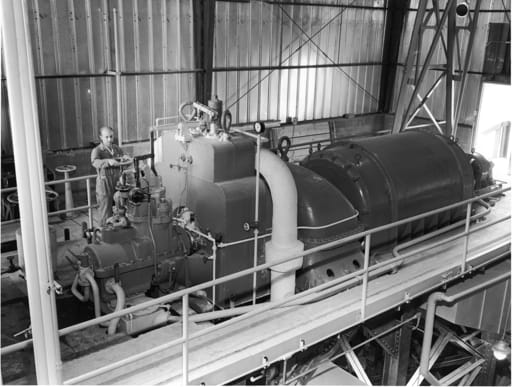
BORAX III reactor inside an industrial facility with an operator interacting with its controls.
To visually tell the story of Idaho’s nuclear and technology evolution:
- INL’s history section includes photos of early reactors, desert infrastructure, and the evolution from the National Reactor Testing Station to today’s INL.
- INL’s Flickr “Nuclear Energy Research” collection contains curated albums of reactors, test facilities, simulation platforms, fuel development, and human‑systems simulation labs—great for showing the “inside the lab” perspective.
- Historic reactor imagery like BORAX III and other facilities at INL gives a strong sense of the lab’s legacy and industrial scale.
These work well as background visuals for timeline slides or “Idaho’s nuclear heritage” sections.
Reactor and lab interiors
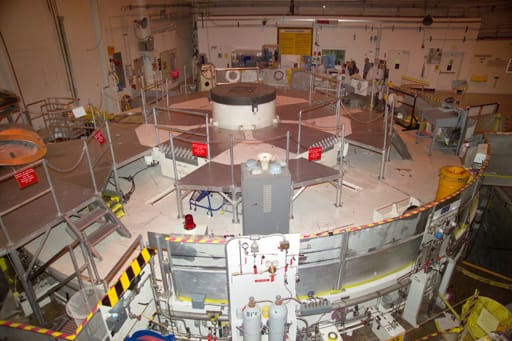
The Advanced Test Reactor.
For more technical or dramatic visuals that match the nuclear‑AI theme:
- Advanced Test Reactor interior photos show the circular reactor structure and control areas, useful for framing nuclear R&D as cutting‑edge infrastructure.
- Cherenkov‑blue core imagery (from the Advanced Test Reactor) gives a visually striking representation of nuclear science that pairs nicely with AI / data‑flow graphics.
- Geocentrifuge and other specialized lab equipment images illustrate the broader scientific environment at INL beyond just reactors.
These can be combined with abstract AI visuals (data streams, neural nets) to create composite graphics for your nuclear‑AI story.
How to use these in your platform
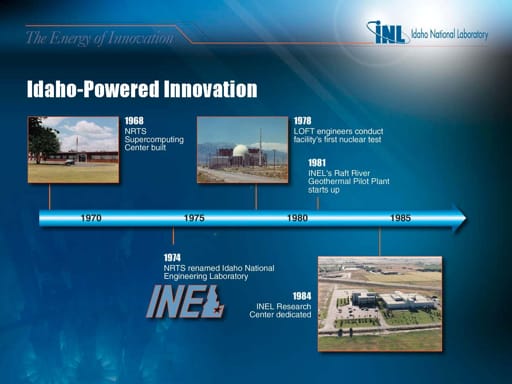
Timeline diagram showing key historical milestones of the Idaho National Laboratory (INL) from 1968 to 1984.
Given your local directory / city‑guide focus, here’s how you might practically use these:
- Create a “Tech & Energy Corridor” section for Idaho Falls / INL using the USGS study area map plus INL facility maps as base layers, then overlay icons for labs, potential AI campuses, and nearby cities.
- Use satellite views for “regional context” cards that show how INL sits between Arco, Idaho Falls, and Blackfoot, reinforcing the idea of a high‑desert innovation zone.
- Mix historical reactor photos with modern campus maps to craft timeline graphics that show Idaho’s evolution from test reactors to nuclear‑powered AI data centers.